Zuspruch

In order to be who we are, we human beings remain committed to and within the being of language, and can never step out of it and look at it from elsewhere. Thus we always see the nature of language only to the extent to which language itself has us in view, has appropriated us to itself. That we cannot know the nature of language—know it according to the traditional concept of knowledge defined in terms of cognition and representation—is not a defect, however, but rather an advantage by which we are favored with a special realm, that realm where we, who are needed and used to speak language, dwell as mortals. —Heidegger, The Way to Language

Heidegger’s meditation puts into words an idea that has been with me, in an unspoken and perhaps obscure way, for many years: that the true “place” of our being is in language; or that the truth of our place among beings is best found there. Language is not merely understood here as an instrument of communcation, as a collection of signs, or as a carrier of meaning, but more profoundly as revealer of being. Everyone who engages with human being engages with language and inscribes themselves as a thinking being there in some way. They inhabit words that are not their own, but common to all; yet their mode of inhabiting those words is uniquely their’s, just as much as it is uniquely given over to the thinking of being that they were, or rather, that they are insofar as they remain thinking in language, by the power of language to continue revealing being. Such is one reason why I write and encourage so highly the thoughtful sharing of words, attentive as possible to the linguistic formulation that the thinking takes. It is not just a trade among phrases, an exchange of ideas, but the profoundest form of our dwelling with one another in time, in our common home, language, which Heidegger elsewhere calls the “house of Being.” (So why pretend like these words might not be the last ones I ever say? We wait far too long to give our final testament. And so we miss our living childhood.)

The notion that our being abides in, and so ought to be entirely committed to, listening (in/to) language, can also be found in Christianity (referring not to the organized religion or any doctrine, but the texts associated with it as an experience, dare I say the experience “Christ” tries to name). John’s Gospel begins with the claim: “In the beginning was the Word, and the Word was with God, and the Word was God.” Sadly, the gripping need to pin this… sovereignty? preeminence? loving space?… of the Word onto one person, a savior reigning peacefully over all things, has probably thwarted generations of believers from thinking through what about the link between language and life (or being) makes such a claim possible; and so the glorification of Jesus Christ kept believers from an even more promising engagement with the Word, from a creative transformation because of It, within and with It (radiant stillness? gracious Saying?). More difficult to think, though perhaps “simpler” by essence, is the primacy of the Word for our being, the Word as realm (or home) of our being as such, down to its most intimate aspects, up to its most shareable; and how this Word calls us to singularity, a point of irreplaceability in the order of things (usually interpreted in Christianity as: God’s unique love for us), where we can speak and give ourselves up to this speaking, to be used for Its abiding-stilling Saying (Christianly: dwelling in the peace of Christ).

All the talk of denying earthly-everyday existence, talk against sin and covetousness, the call to die while living, to lay down one’s life in friendship: all of this finds its unity, not in a hatred of mortality or in restrictive morality, but in this insight: that our being comes from and returns to the (giving-given) Word, which transcends all attachments and desires of the flesh, all will-to-power, the entire metaphysics of subjectivity that Heidegger himself constantly tries to deconstruct. All of our life is already a survival, structured according to traces we share with others and keep not for ourselves; thus Christianity’s ruthless condemnation of riches and property, its call to “the highest poverty” where things are “used without using them up,” things are done as not-doing them. “Presence” (parousia) is inseparable from a work of mourning that cannot be completed; our destiny is in loving remembrance (of the other), which charges everything with an unknown destiny (beginning with the present, beginning with each word). To make the word flesh is what I owe you as a thinker of being who thinks with you. The word as flesh is how you have always appeared to me, which does not at all mean that you only are what you say; on the contrary, your body’s every movement is verb. Our entire being “says something,” shows something, let’s something appear. Without that factum, there’s just rot and machine, nothing visible or hearable about me or you or humanity in general. But how much there is of us to see and hear!

The Word said, “Abide in me and I will abide in you.” Fantasies about being absorbed by some metaphysical person can be left aside here. Sharing a body with God and/as sharing a body with all people; life after death and/as life in the other or in the future; resurrection in a spiritual body as undying existence in the word consecrated to the thinking-revealing of being; the remaining, therefore, of what is “proper” to one, one’s soul, for all eternity in this common space, language; the justice to be done at the end of time, when every testimony will be heard; the word of faith dwelling near to the heart forever, spoken beyond human understanding, effective in its very act and utterance—all of this can be, needs to be, rethought along the lines of Heidegger’s thinking: “man finds the proper abode of his existence in language.” Paul put it like this, likening the Lord to the “unknown God” of the Greeks: “He allotted the times of existence [of all people] and the boundaries of the places where they would live, so that they would search for God and perhaps grope for him and find him—though indeed he is not far from each one of us. For ‘In him we live and move and have our being’; as even some of your own poets have said, ‘For we too are his offspring.’” Now, we are smart enough to rethink the “he” Paul is referring to here as, perhaps, the mystery of the Word itself, or as Being(-logos). We are smart enough to not be scared by the religious nature of all this and, inventively, venture new interpretations, new paths to and through language, for the sake of rendering clear the stilling Saying whose offspring we are.

Ultimately, these new paths to language will command a different respect for what we so facilely call “words”–our relation to them, our strangeness in them. At stake in language is what our entire being “says,” shows, lets-be-seen. How much truth of Being can we stand? And how could we stand it, without words? No mortal ever sees or comprehends this letting-be-seen in its entirety; perhaps we are only given a sentence-by-sentence glimpse of what we have contributed to the “revelation.” Yet, in another way, we never cease, will never cease, “saying” it. Different respect for that means a different respect for others—for the otherness of the other(‘s word): the unknowability of their being insofar as any knowledge of their true belonging in/to “language” totally escapes us as individual mortals, even as it is preserved there and demands our attention. It calls for a different politics, for a different relation to time and intervention in the social. It bespeaks another kind of body, another kind of extension, another story of giving life. It calls us to think our responsibility to the Saying and to ask what we must do “in remembrance,” “in thanks” of such being.

For what would it mean, finally, to be thankful for, “that which in the event gives delight, itself, that which uniquely in each unrepeatable moment comes to radiance in the fullness of its grace”? As Heidegger confessed, “To guard the purity of the mystery’s wellspring seems to me hardest of all.”

Such a work of guardianship at the origin of language, where the word is made flesh and our flesh is given over to our true life in the word, would revolutionize our thinking about personhood, self-image, personal narratives, what sort of responsibility is due in all that we Say, what sort of realm our utterances are ultimately given over to, and so on. Who has really understood what it is to be heard as an entirety speaking? Who is it who would see everything we have let be seen through our saying-showing word, the gesture of our existence? Surely, it is not we ourselves. What sort of secret is this? What is a person, a signatory, a thinker? Where does it get its sense, its unity, its (in)visibility to others? How is it, or how does it become, touchable, memorable, lovable? We are recalled again and again to our reality in the word: an absolute mystery in which we never cease trembling, an inappropriable gift no reception can receive, the miracle of a testament moving and staying, “heaven on earth,” created-discovered, heard-spoken, word by word, trace by trace: a “silent” (speechless?) surprise stroke over the abyss, promising fast everything: delivering us back somehow to our origin, over there, in the heart of other people. What then makes the impresentable, impenetrable essence of “us” so communicable? To what do we owe this grace—this pleasure?

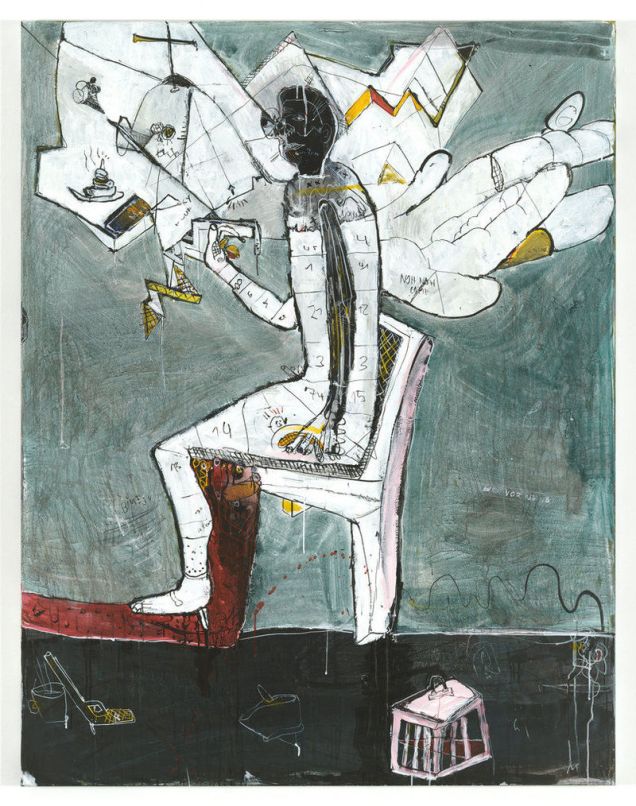
from April 2016marcel_eichner_6(Image: Michael Eichner, Untitled)
Posted in Uncategorized | 1 Comment

Avian Stripes

The lust after silence is a remnant of the philosophical desire for superiority, excellence, elevation, and purity — poetry is its material machine, its ideal reflection.

But Baudelaire’s desire, learning from Poe, was different: a literature that would paint modern life in all its crowdiness, without animosity or resentful critique à la Nietzsche. An embrace of the disconcerting flux of bodies is not at odds with a sensibility for the rare, which silence symbolizes and never fails to recall, but that appears jeopardized in a noise-filled world. This thesis was however disproven by Cage, who affirmed silence to the extreme, but this time through the refutation of its possibility: zen for New York City like a flower of evil for Paris. These advancements, however elitist they seem, are undoubtedly developments in the direction of a Marxian fusion of theory and the masses — against a Mallarmean verse of the void and a Malerian tragedy of tones, though not without sharing a few traits. Ennui and play, within the frame of no escape from the city: these are the terms for a liberation of aesthetics from its philosophical overdetermination by silence.

But they are not yet the sparrow in the cafe, who fascinates us with his graceful swoops, his clever pecks and steals. His naturalness, so expected yet so photogenic, announces a miracle to us: he is as comfortable here as he is in the woods, and no doubt does not make the differentiation. His presence punctuates our planned afternoons, accompanies our downtime — or, for those whose feathers ruffle easily, he is a nuisance to be shooed away, an unwelcome guest who does not belong at our tables. The attitude of aristocratic thinkers toward the new generic thought is simliar: curious, tiny, and constantly in flight, it is at first tolerated, mostly because it is so cute, until it starts snatching crumbs and interrupting the conversation, whereupon it annoys and annoys even more as it so easily hides away; thus it provokes surveillance, ruining the meal even when absent.

Meanwhile, children go on chasing after it, not to catch it but to befriend it and learn about the shifting movements of its head. St. Francis was not by accident an early herald of the generic: he realized a simplicity of immanence that not even the transcendence of Christ could complicate. This loving preacher to birds understood a silence that the enlightened elitists cannot help but  transform into the sublime presence of a void. In the name of purification and peace, they hang a sign telling the birds they aren’t allowed here, and erect a million walls, debate a thousand problems, just to avoid a confrontation with the generic. They return always to their spiritual journeys and flights, unable to see the simple elevations dancing before them.

The fusion of theory and the masses requires a practice as clever as the sparrow in the cafe and thus equally capable of capturing the childlike attention of any human. The old idea of aesthetic excellence should be displaced in this direction. It is absurd to imagine birds erecting a nest to wow humans, but their murmurations, their unisonical flights and formations, impress us without them having to know a thing about it. We too must invent new knowledges, and make them dance to a new use that ‘impresses’ without reflection or recognition, without oeuvre, with only the working itself — but this time a lived work, as simple as the birds’, who do not scrounge for crumbs but play a game with finding them. Our crumbs are all the knowledges, thoughts, and events that strike us as we move through the crowds and libraries, here understood in their radical equality, their equal useability, for generic thought.

Like the sages of old, we too know how to be quiet, but it is not the quiet of withdrawal or rarification; it is the quiet of the bird’s wing, transporting a tiny body from rafter to floor and back, from table to open sky. Excellence remains here, but it is no longer the aesthetic replacement of the banal, that ‘monotony’ from whch we seek refuge in vain. For the birds, nothing is monotonous about the city: one time each time, they peek and peep, each time in a different corner, for a different crumb. They never return upon the same place, but fly their patterns in a novelty of immanence with the grace of a knowledge they are without knowing it.

Generic thought, too, knows this, without learning it — and look, it has already hopped on to someplace else.


Posted in Uncategorized | 7 Comments

Evil Compassion

If we immoralists do harm to virtue? No more than anarchists do to princes. Only after they’re shot do they again sit firmly on their throne. Moral: one must shoot at morality. –Nietzsche

There is a necessary — but only because morality is so stubborn in its “necessities”! — link between evildoing and the exploration of the human possibile, for such research inevitably breaks with is expected from standard behaviors and outlooks, from whatever is predictable based on a known arrangement of the world. Where humans are increasingly dispensible and submitted to the harshest homogenization of character, the pursuit of the possible demands insistent and thoroughgoing insubordination, an active combat against all aesthetic and moral conditioning, and a rigorous skepticism regarding the validity of every horizon and every rule. There is then no way to avoid doing violence to the known patterns and, moreover, to those with whom one interacts intimately — those whose patterns one often surveys with discomfort, and regularly with disgust. It follows that there is no way to avoid feeling guilty for this exploration and the rejections, the recoil from the comfortable, that it implies, though this “transgression” only is one from the side of regulation, whereas from the side of exploration, it appears a liberation, albeit one at the limits of conscious control and always risking a measure of criminality and abuse — for it means experiencing, “the terrible cleavage which separates [us] from everything that is customary or reputable.”

Unless of course one has been disabused of their adherence to cultural “meaning-well,” to the paranoid and backward glances that seek common recognition and approval, and has replaced complacent irony with an irritating battle for truth. Such a one begins not from disenchantment, negation, and critique, nor from some will to infringement, but from an affirmative existential ingenuity that reckons with its highest chances within the circulating All constantly being revealed — the main playground of interaction and intervention,  the one thing worthy of its Dionysian faith. It was Nietzsche’s ambition to harden his readers against all flimsy forms of sympathy for humanity, understanding that “man” was an undefined animal: a promise, a transition, a bridge toward another form of life acutely aware of its own eternity — its own style of arrowing into the unknown, its refusal to believe in the flimsiness of that uncourageous being so inhibited in his language and his manner, so caught in dull desires and fears: the modern liberal man. Instead: an explosive clandestinity whose every artifact is dynamite, ready to release its mercurial energy and spark off new paths; a posthumous tenacity that knows how to overflow and waste itself forever; an “evil compassion” that knows the depths and correct consequences of pity…

What is nihilism? It is to believe that the limits of a situation, and thus the limits of what is possible for us in it, are known with certainty, that they could never stretch beyond these supposed “limits”; in other words, that determinations of the given (its coordinates, its variables, its layout of finite beings) are adequate to determine action, or constrain it absolutely (this bias in fact liquidates the possible, turning it into nothing more than an extension of “reality”). Nihilism is then an excuse to not experiment with morality; to not disrespect boundaries and cross limits, sensible or conceptual; to not challenge norms of thought, presentation, behavior; to not work in the strong poetic sense of the term, where work implies singularization of and participation in the general intellect or a generic truth; in short, to not make of oneself an unbending antagonistic element in the world that is in no way and nowhere identical to anything that is. But we know that such denials of potentiality lead to interminably confused comportments, leaning now towards cynicism, hatred, and hopelessness, now towards a frantic and paranoid fixation upon every global horror from terrorism to populism, now towards a freewheeling acceptance happy to dance out its frustrations, a facile generosity that pontificates about love’s power, all modes of an insidious “let it be” attitude that binds us to the so-called present and accustoms us to the monotonous run of a lost citizen: a beetle who sometimes sparkles in the sun like an opal but for the most part buzzes around in darkness, ignored — unless of course it infests something…

Nihilism is a belief in the sufficiency of any determination of what is, of how it is, of how one is, of what the future will be, in short, of what can or even might be (known, created, changed, destroyed). To turn one’s back on this presumed sufficiency of the thought-world necessarily leads to offense — but offense is not the goal, nor the non-nihilist’s point of pride; it is rather an effect of the search for future causes, for novel grounds of creativity not legitimated by any given situation or horizon of sense — causes that remain essentially unknown and suspended in their sufficiency, thus in constant contact with their own evental conditions, their own force of potential and means of invention. In Nietzsche’s words: “Excess force in spirituality setting itself new goals.” Bataille adds the following: no one can go to the limit of the possible on their own. Our behavior toward friends must be motivated: to shake them from their torpor, their sufficient egos and work-projects; to violate their good sensibility of self; to reduce their attachment to the appearing world to a minimum; in short, to declare war on them for them — for the war we believe they are on the verge of realizing they are. Such prodding gestures, which are never guaranteed to suceed and indeed seem futile from the point of view of worldly “effectivity,” must be as politically charged as they are symbolically challenging. They must be flexible enough to enter individuation processes without alienating the target audience from the generic potency of their life-world. In the end, the most basic sufficiency to be denied is that of ‘myself’, of being qua being, of any totality of consciousness whatsoever — for this alone can genuinely open the floodgates of creative expenditure.

For explosive beings, personal life seems to fall into shatters because it stops looking after itself and its preservation — but again this is only an effect of the search for intenser causes and new goals; it only looks “necessary” from the perverted and hegemonic perspective of person-moralities. The latter will always seek to calm the nerves and restore harmony; it will seek psychological explanations or hide behind historical details; it will try to dismiss the ennerving quality of every artefact that does not readily fit within a universalizing frame. Whereas a veritable theater of cruelty emanantes from whoever has loosened the grasp of these shit-based economies of presence, in comparison to which the nothingness of opening toward “possibility beyond measure,” this infinite “dance inside out” (Artaud), actually looks quite scrupulous and discreet. Their efforts, dedicated to a humanity of-the-last-instance, could only be labeled “evil” by those already programmed beyond hope by the lie of “lifetime value” — of beetlehood. For the beetle can hardly do more than “dance on its own,” swear it’s only human, and imagine a world in which everyone “lives for today”; its only salvation is the ephemeral moment it respiritualizes or reinvests with selfhood and deep meaning however it likes; its dreams are calculated like pathetic bucket lists, or else flow through pipes corroded by a thousand cliche-chemicals and market additives; its imagination stretches no farther than the known kerfuffle; it contrives to brainstorm what should be done but only generates an endless commentary that transforms no one because it fails to transform itself in the process; it could not stand to be resurrected, and so it dies tomorrow…

Who is this beetle, the addressee of all this “vitriol”? Can its accuser really be so “conceited”? We couldn’t bear to see such a monster in person; he must be seething! — So speak the last men and blink, thinking they have heard yet another resentful, critical discourse. Why? Because they deal in packages whose dimensions are knowable and dish out judgments that are just as small and compact; because they have no nose for expressive tendencies, for vectors of futurality, for the sort of effort and offensiveness necessary to let man pass beyond his moral prejudices; because he can only see anger and prohibition and limitation here; because he does not know how to put the shame he legitimately feels to good use; because he can only view action as a minor modification of fate and happiness in his own sphere and, looking for a recipe for health and happiness, has no idea how the displacement of the certainty-center can “change everything”; because he is a nihilist who feels little more than remorse and resentment in himself, who knows nothing but his beetle shell, who believes in gravestones and lacks all sensitivity for “impossible symbolic exchanges” (Baudrillard); because, finally, he does not yet understand the necessity of evildoing — of demolishing the democratic fetishes and familial fantasies that hold humanity hostage to figures like the town drunkard, the disgruntled customer, the angry voter, the husband snoring in his man cave, the woman dissatisfied with her looks, costumes so imposed by the culture industry that those who wear them cannot help but identify with them and worry about their figure, their image, and their happiness, thinking it’s all on them, without any idea of how to disengage or disrobe — indeed, who are we addressing if not these nihilists of blind passivity who suffer the paralysis of one seized in a night terror?

Yet let us not wake them too soon. Let us not sympathize with their hurt so mechanically. Let us not console them with easy words of consolation and morale-boosting, for we know what deep slumbers that could unleash. For we know it is a disservice to stroke a weak conscience and sooth it with gracious, premature words. Let them instead burn in the purgatory of their own unambition; perhaps they will understand that at stake here is an evil one does to oneself in seeking alternative causes — that such evil might even prove to be compassionate, the only way to respect humanity and honor what it could be.

Posted in Uncategorized | 5 Comments