Non-philosophy claims to be a science of philosophy, able to observe and isolate a system at work in it globally, so much so that instead of remaining within this system it can treat its various idea-complexes as symptoms. In later texts, this requires the invention of a quantum physics of philosophy or its quantic deconstruction, which will bear on concepts themselves and not just texts. There are two basic sides to the non-philosophical endeavor: to diagnose the philosophical symptoms of transcendence; and to invent its own machines or matrices that modelize radical immanence. Both sides proceed through the use of “oraxioms” emptied of their sufficiency, thus “weakening” discourse. These are the property of no ‘ego’ but of a ‘we’ as “quantum of expression,” at once lived and generic. Non-philosophical texts are everywhere the invention, expression, and practice of these oraxioms. Thus the confusion for many readers who feel confronted with yet another batch of neologisms from yet another eccentric philosopher. It is difficult to recognize that in-the-last-instance they have no recourse to the philosophical languages they transform. Devoted fans are sent down the perilous path of trying to ‘decipher’ yet again the ‘meaning’ of these supposed neologisms, striking deals with philosophy and thus dooming it to mixture and incomprehension. As for philosophers, they develop an uneasy resistance to non-philosophy that is even stronger than their resistance to science, because unlike the latter it cannot be subdued or hierarchized so easily, for non-philosophy has brought, however ‘indirectly’, a scientific-type thought to the terrain of philosophy, while at the same time placing both science and philosophy under the condition of a generic man. Indeed, it is in the name of a generic transformation of all the productive resources of thought that non-philosophy stakes this claim to be a science of philosophy. To liberate those resources from their self-constraint is one of its primary aspirations.
In this installment of the series, we will again opt to do little more than diagnose, hoping that by clearly illustrating the philosophical system we can loosen some resistances to non-philosophy, which in our view is justified in calling itself a radical treatment of that system, even if it is clear that no single text, indeed no text at all, could ‘manifest’ this in a transparent way. Because the material at non-philosophy’s disposal is of philosophical origin, even when it treats it scientifically, the evidential ‘output’ is, or rather objectively appears to be, philosophical. Only the choice to shift the base for thinking will ‘suffice’. A different style of philosophical materiality is required, one that no longer treats concepts as bodies and bricks, as interlocking parts or referential loops, as noematic isolates, in sum, no longer as trajectories arrayed in a predetermined space, whether that be the text in consideration, the tradition, or the world itself. Instead, concepts and styles themselves are to be treated as interfering waves, underdetermining each other by quantic superposition, in a flux of immanence that never forms a field or plane. If we focus provisionally on diagnosis, we do so with this altered materiality of style in mind and try to practice it. This may appear like a lack of concern for detail, like a mess of strokes too broad. These charges are often leveled against non-philosophy, and from the perspective of philosophy rightly so. But it has no need or desire to defend itself against them, quite simply because it has different goals–to defend humans from the constraint the self puts on their productive resources. Suffice it to say, a non-corpuscular but wavelike materiality in concepts implies a different approach to the world of philosophy, and not just when it comes to texts. In the end, it is up to the reader to discern to what extent the collision of conceptual particles in this non-philosophical experimental chamber is not merely a free-associative scramble. Continue reading
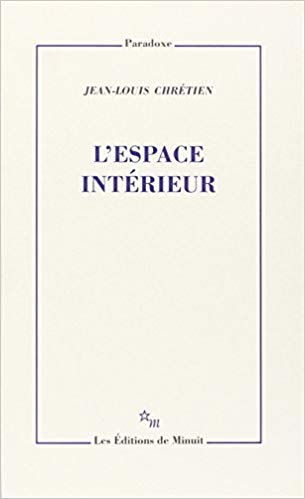 The crucial difference is this: where contemporary thought sees an increasingly isolated psyche struggling to gain control of its unconscious tendencies and become master of self and world, the Christian “topic” instead focuses on the edification, exploration, and expansion of an interior space in which God may dwell. Of prime importance here is the presence of infinity or alterity that we “house” potentially within ourselves, or even more strongly, whose residence we are. The book draws on numerous figures present in the Christian tradition from its inception, from the chamber of the heart (Matt. 6:6) to St. Theresa’s Interior Castle, to illustrate the energetic, dramatic, and libidinal-economic dynamics at play in the Christian topic of interior space. Each chapter ends by showing how modern thinkers appropriated and twisted these figures, stripping of them of their God-orientation and tipping them progressively toward the “kingdom of subjectivity.” Chrétien’s aim, however, is not
  fragilekeys